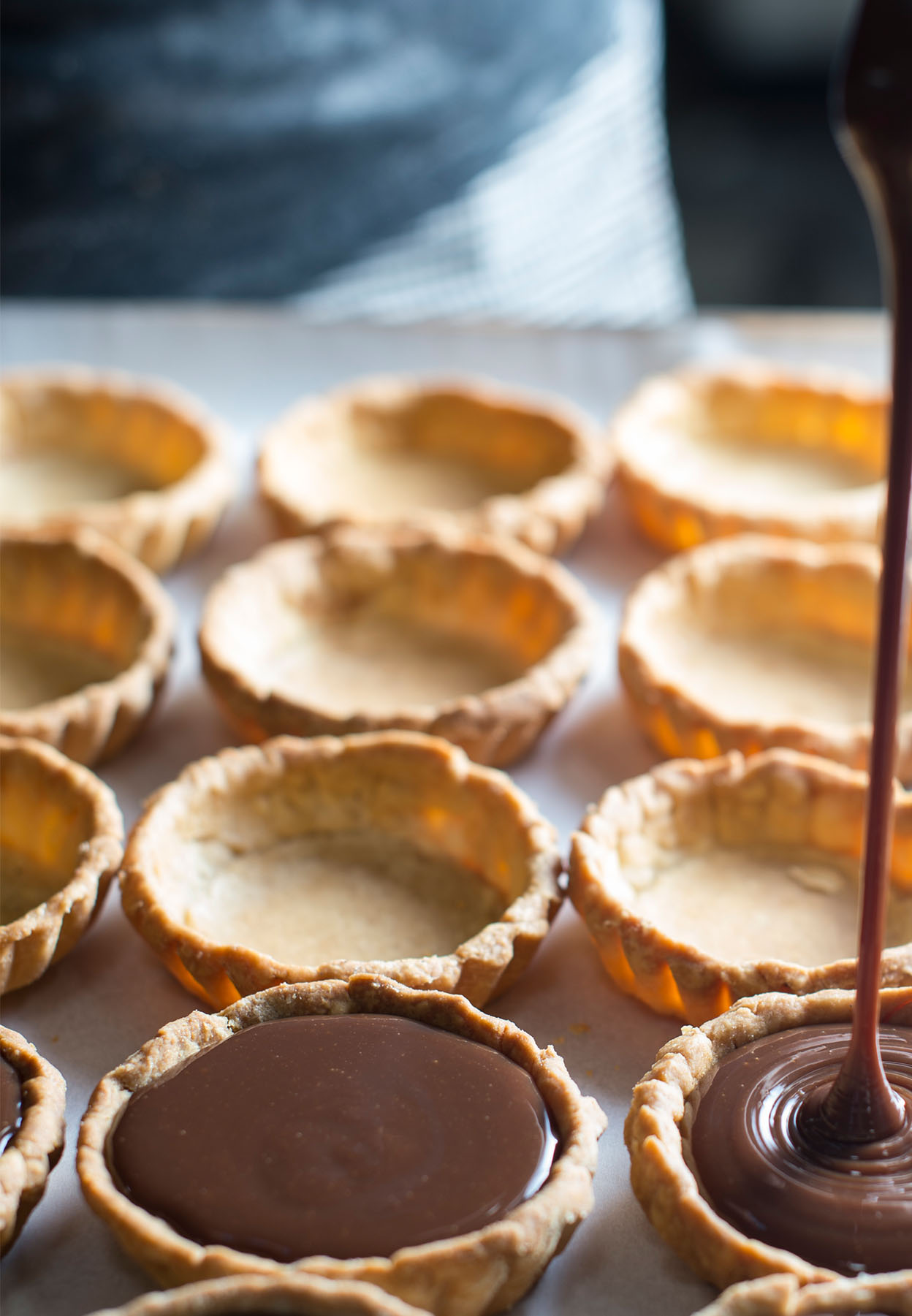
Sweet Shortcrust Pastry (Pâte Brisée)
Makes
1
Ingredients
400 g (14 oz) unsalted butter, chilled and cut into 1.5 cm (⅝ inch) cubes
20 ml (½ fl oz) vinegar, chilled
100 g (3½ oz) caster (superfine) sugar, chilled
170 ml (5½ fl oz/⅔cup) water, chilled
665 g (1 lb 7½ oz) plain (all-purpose) flour, chilled
5 g (⅛ oz/1 teaspoon) salt
Description
This pastry will have a slightly uneven edge around the rim of the tin, resulting in a tart that looks rustic and home-made, which is what we aim for at Bourke Street Bakery. If you are after a perfectly even effect, this is not the pastry to use — this dough has water in it, which means it will shrink as the water evaporates during baking; the following method is to help counteract this shrinkage. If you are looking for a perfect result, use the Sweet Pastry (Pâté Sablée) recipe, but keep in mind that it is a far more fragile dough than this one.
The number of tarts you end up with will vary, depending on how thinly the pastry is rolled. The pastry can be frozen for up to 2 months, so it makes sense to line all the shells with foil (ready to blind-bake), store them in the freezer, then blind bake them as you need them. You do not need to thaw them first.
This recipe makes one 28 cm (11¼ inch) tart, two 23 cm (9 inch) tarts, twelve 10 cm (4 inch) tarts, or twenty 8 cm (3¼ inch) tarts.
Method
Remove the butter from the refrigerator 20 minutes before you start mixing — the butter should be just soft but still very cold so it doesn’t melt through the pastry while mixing.
Put the vinegar, sugar and water in a bowl, stirring well. Set aside for 10 minutes, then stir again to completely dissolve the sugar.
If mixing the dough by hand, mix together the flour and salt in a large bowl and toss the butter through. Use your fingertips to rub the butter into the flour to partly combine.
If using a food processor, put the flour and salt in the bowl of the food processor and add the butter, pulsing in one-second bursts about three or four times to partly combine. You should now have a floury mix through which you can see squashed pieces of butter.
Turn the dough out onto a clean bench and gather together. Sprinkle with the sugar mixture and use the palm of your hand to ‘smear’ this mixture away from you across the bench (a pastry scraper is a useful tool here). Gather together again and repeat this smearing process twice more, before gathering the dough again. You may need to smear once or twice more to bring it together — you should still be able to see streaks of butter marbled through the pastry; this gives a slightly flaky texture to the final product.
Divide the dough into two equal portions and shape into two round, flat discs, 2 cm (¾ inch) thick. Wrap each disc in plastic wrap and chill for at least 2 hours or overnight.
Remove the pastry from the refrigerator 20 minutes before you wish to roll it. Sprinkle a little flour on the bench and rub a little flour over a rolling pin. Working from the centre of the pastry, gently roll the dough away from you, then turn the dough about 30 degrees and roll out again. Repeat this process until you have a flat round disc, about 3 mm (⅛ inch) thick. Sprinkle extra flour over the bench and rolling pin as needed, but use it as sparingly as possible — if too much flour is absorbed into the dough, the pastry will end up with poor flavour and texture. Bear in mind that you are trying to flatten the pastry into a disc, not ferociously stretch it out in all directions. Stretching will only cause the pastry to shrink excessively during baking.
Transfer the pastry to a tray, cover with plastic wrap, and refrigerate for at least 2 hours to allow the gluten to relax.
To make one 28 cm (11¼ inch) tart shell, roll out the pastry to 4 mm (³⁄₁₆ inch) thick and cut it into a 30 cm (12 inch) disc. Knead the excess dough back together and roll it out again to get a few smaller discs to keep in the freezer.
To make two 23 cm (9 inch) tart shells, roll out the pastry to 4 mm (³⁄₁₆ inch) thick and cut it into a 25 cm (10 inch) disc. Knead the excess dough back together and roll it out again to get a second disc.
To make twelve 10 cm (4 inch) tart shells, about 3cm (1¼ inches) deep, roll out the pastry to 3 mm (⅛ inch) thick. Cut into eight or nine 12 cm (4½ inch) discs. Knead the excess dough back together and roll it out again to get the balance of the 12 discs.
To make twenty 8 cm (3¼ inch) tart shells, roll out the pastry to 3 mm (⅛ inch) thick. Cut into twelve 11 cm (4½ inch) discs. Knead the excess dough back together and roll it out again to get the balance of the 20 discs.
At Bourke Street Bakery, we prefer to use loose-based tart tins and moulds, which have sides that are at an angle of about 90 degrees to the base. The right angle offers more support than sloping sides and makes it easier to remove a fragile tart. Again, it is important not to stretch the dough when lining the tins.
Place the pastry on top of the tart tin/s, ensuring it is in the centre, and use your fingers to gently push the pastry into the tin/s, moving around the rim until all the pastry has been inserted — you should now have about 1 cm (½inch) of dough hanging over the sides. Use your index finger and thumb to work your way around the edge, forcing the pastry into the mould so that little or no pastry is left protruding. Where the upright edge of the pastry meets the base, there should be a sharp angle where it has been firmly forced into the corner — this method of lining the tin is to counteract the pastry shrinking once baked.
Set the pastry cases aside to rest for at least 20 minutes in the freezer so that the gluten relaxes and holds its shape when you line it with foil.
Once the tart has been lined and rested, most recipes will call for it to be blind baked. Blind baking pastry simply means you need to pre-bake the pastry before filling it, to ensure the base is crisp and cooked through. If you own a pizza stone this will work perfectly, as long as it is heated well and the pastry tin/s are placed directly on the stone.
Preheat the oven to 200ºC (400ºF). Line the pastry with a double layer of foil, making sure the foil is pushed well into the corners. Pour in some baking beads or uncooked rice to fill the case. The blind-baking time will vary considerably from oven to oven, but the 8 cm (3¼ inch) and 10 cm (4 inch) tarts will take 20–25 minutes to cook, and the larger tarts 30–35 minutes. When cooked properly, the pastry should be golden all over, particularly in the centre, which tends to be the last part to colour and become crisp.
Once cooled, the tart shell/s are ready to be filled.