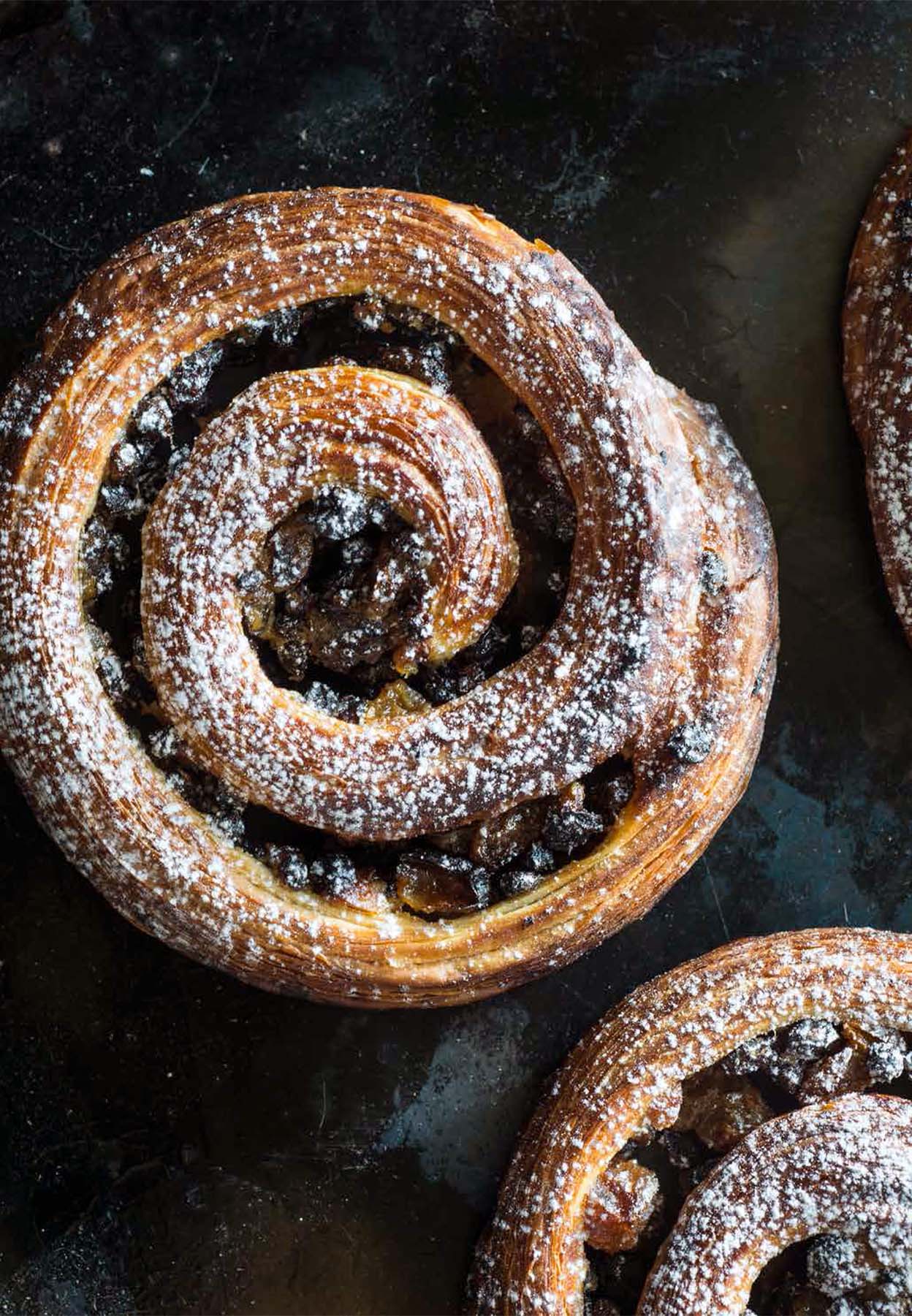
Pain Au Raisin
Makes
40
Ingredients
1 quantity croissant dough
250 g crème pâtissière
1 quantity egg wash
icing sugar mixture, for dusting
900 g sultanas
300 g currants
1.75 litres boiling water
100 g soft brown sugar
1 teaspoon mixed (pumpkin pie) spice
A French breakfast classic, known in Australia as a ‘snail’. Early in the morning, we often find the pale English face of our friend Alan Benson (best food photographer in the world, but average at people — just look at our head shot) squashed up against our fogged-up shop glass, trying to force his way in to eat trays of these, his favourite pastry. Alan, thanks for making this book visually delectable! You’ll need to plan ahead for these, making the fruit mix and crème pâtissière at least one day in advance.
Method
To make the fruit mix, place the sultanas and currants in a mixing bowl. Pour over the boiling water and set aside to cool. Cover with plastic wrap and refrigerate overnight, or for up to 2–3 days.
Drain the fruit well, then add the sugar and mixed spice, stirring to combine. Set aside.
Remove the rested croissant dough from the refrigerator and roll it out into a rectangle measuring approximately 35 × 100 cm (14 × 39½ inches) and about 3.5 mm (⅛ inch) thick. This may take some effort, as the dough can spring back as you roll it. If this happens, rest the dough in the refrigerator for 10 minutes, then continue rolling. You may need to repeat this process several times. If the dough becomes too large to fit in the fridge, simply fold it over, place it on a tray and chill before continuing.
Cut the dough in half to form two 35 × 50 cm (14 × 20-inch) rectangles. Place them on baking trays lined with baking paper and rest in the refrigerator for 10 minutes.
Lay one sheet of dough on a lightly floured work surface, with the shorter edges running away from you. Spread the crème pâtissière evenly over the dough, right to the edges. Scatter over half the fruit mixture, spreading it evenly but leaving a 2–3 cm (1-inch) border along the edge furthest from you.
Over the years, we’ve increased the quantity of fruit significantly, so take care when rolling—the filling is generous. Starting from the edge furthest away from you, roll the dough tightly towards you, as if rolling up a newspaper for delivery.
Wrap the rolled log tightly in baking paper and place it in the refrigerator for about 20 minutes to firm up. Repeat with the remaining sheet of dough.
Remove the baking paper from both logs and transfer them to a clean work surface. Using a sharp knife, cut each log into slices about 2.5 cm (1 inch) thick.
Arrange the rolls on the lined baking trays, leaving plenty of space between each one. (At this point, you can freeze some of the rolls for a few weeks. When ready to bake, transfer them to the fridge the night before, then prove and bake as directed below.)
Cover the trays loosely with a damp tea towel or damp muslin (cheesecloth). Set aside in a warm room, ideally 26–28°C, for 2–3 hours, or until the rolls are almost doubled in size. If the cloth dries out, lightly spray it with water.
Preheat the oven to 200°C.
Lightly brush the tops of the rolls with egg wash and place them in the oven. Immediately reduce the oven temperature to 180°C and bake for 13–15 minutes, or until deep golden.
Allow the pastries to cool slightly on the trays, then dust generously with icing sugar before serving.
note
The passionfruit curd will keep in the fridge for up to 5 days if covered directly with plastic wrap. Once the tarts are filled, they’re best eaten within a few hours.